Showing posts with label Liverpool. Show all posts

Tuesday, 21 January 2014

Manchester United – the potential financial cost of failure


It’s crystal clear that a Champions League place, that sad modern non-trophy victory we’ve watched Arsenal "win" in recent years, is the most Manchester United will achieve in the league this season.

But what if even a top four finish or, whisper it, the Europa League, prove out of reach? How much would United’s profitability be harmed?

This post looks at how much the club earned last year from the Champions League, how much a Europa League spot would provide instead and the implications of no European football at Old Trafford for the first time since the Berlin Wall came down.


The lessons from LFC

In the long-term, repeated failure to qualify for the Champions League would damage the club’s ability to negotiate the sort of commercial contracts that have been so important to United’s finances in recent years. In the short-term I do not see significant risk to commercial revenue from one (or even two) seasons on the sidelines. If this seems blasé, the evidence from Liverpool is that such damage takes a very, very long time to have an impact.

In 2011/12, the last season for which we have figures, Liverpool FC had the 6th highest commercial revenue in European club football (of course City, with the fifth highest, have the benefit of a suspicious number of Abu Dhabi companies queuing to give them money). Liverpool, who haven’t played in the Champions League since 2009/10, had higher commercial income than Arsenal that season. Furthermore the club’s decline hasn’t prevented more deals being signed since 2012, with companies like Chevrolet and Garuda.

Where United may be vulnerable if the current slump persists, is the very fact that the club has pushed the boundaries when it comes to sponsorship. Manchester United have identified numerous industry “verticals” where football clubs have never attempted to find commercial sponsors, hence the official “office equipment supplier”, “medical systems partner”, “savoury snack partner”, “motorcycle partner in Thailand”. These deals are unproven for the “partners” and may be more vulnerable if the football club isn’t on the top stage for several seasons.


TV cash

The most obvious impact of not finishing in the top 4 (or implausibly winning the Champions League to ensure qualification, hello Chelsea), is the loss of TV income.

In 2012/13, United earned £31.3m in CL broadcasting revenue, which accounted for 8.6% of the club’s income (the third most important source after PL TV money and the Nike contract).

The bloated Europa League is the financial poor relation of the Champions League. A club getting from the group stage all the way to the semi-finals in 2012/13 would have earned €4.7m (around £3.8m) before payments from the competition's market pool. For a club from a large nation like Italy, Germany or England, the market pool payment could add €3-4m more. The most United could earn from actually winning the Europa League (hardly a certainty obviously) would be around €14m (about £11m), a loss of £20m compared to 2012/13. A more plausible run to the quarter finals would bring in around £7m, a loss of £24m.

Europa League (to the quarter-finals): £24m lost income
No European football: £31m lost income


Matchday

At United, Champions League matches command premium prices for season ticket holders and members. Cup games, including European matches are however included in seasonal hospitality packages. What would happen to hospitality prices if there was no European football for a season is one of the great uncertainties in analysing the financial impact on United. I find it hard to believe the club could hold the prices of executive seats and boxes whilst the number of home games falls from a “normal” 29-30 per season to as potentially few as 19 or 20 (the exact number in a season with no European football obviously depends on the draws for the domestic cups).

The Europa League clearly lacks the appeal of the Champions League, and another factor to consider in the event that United ended up in the second tier competition, would be whether the EL would be included in the daft “Automatic Cup Scheme” that compels season ticket holders to buy their ticket for cup games even if they don’t want to/can’t attend. When the club ended up playing in the competition in 2011/12, the games were excluded from the ACS, to much relief from many fans. Would the management be so generous if the Europa League was the only European football on offer?

There is also a possible impact on summer tour revenue if United had to play in July Europa League qualifiers (although there would be home gate receipts to compensate). All these uncertainties make it very hard to predict accurately the impact on Matchday revenue of either time in the Europa League or no European football at all.

One useful way to consider the sums involved is to look at how Matchday revenue has changed in recent years in response to the changes in the number of home games. A home game generates around £3.8-3.9m of revenue.


Assuming a season with no European football at all and two home cup games, to make a total of 21 home games, the impact would be around £20-25m of lost income. In my view a season in the Europa League might be expected to cost around half that figure from lower attendances.


Europa League (to the quarter-finals): c. £10m lost income
No European football: c. £20-25m lost income


Cost savings

The current terrible season means of course no substantial bonuses for the playing squad, which could save the club around £7m compared to the title winning year of 2012/13.

Fewer cup games saves the club money on match day staff, policing and other related costs. In total, a season with no European football could see cost savings of £2-3m from a locked up Old Trafford.

No European football: c. £2-3m cost savings


The Glazers, the share price and investment

Manchester United’s owners and the club’s board are not stupid and the possibility of one or more years out of the Champions League has no doubt crossed their minds.

The SEC filings the club has had to publish since the IPO show that the scenario is part of the club’s planning. The club can actually be released, twice (in non-consecutive years), from the covenants built into its “Revolving Credit Facility” (think of these as the financial rules governing United's emergency overdraft) if it fails to qualify for the Champions League.

One season, or even two, of failure to qualify for the Champions League doesn’t destroy the Glazers’ business model which envisages ever more commercial relationships and ever greater TV deals. What it definitely does do is make the already expensive shares look very expensive.

A fifth place league finish this season means the club will make EBITDA (cash profits) of around £120m (depending on what happens in the Champions League knock-out stages). At the current share price that values the club at 15x EV/EBITDA ("EV" is "enterprise value" which is market capitalisation plus net debt). No Champions League football, even allowing for more commercial growth (such as the Chevrolet contract and a new kit deal) pushes that multiple up to around 19x. For a company where profitability is failing and which needs to invest more cash to remain competitive that is very expensive.

Europa League (to the quarter-finals): EBITDA down c. £30m in 2014/15
No European football: EBITDA down c. £45m in 2014/15

The big question the owners and Ed Woodward face if things continue poorly on the pitch, is whether they will properly back David Moyes and invest in the squad. The club proudly stated in the IPO prospectus that average annual net transfer spend over the last 15 years (from 1997/98) had been £14.3m (or £20.1m excluding Ronaldo, which one shouldn’t). That level of spending is far too low for any major club, let alone one that has let its engine room decline over years, a decline masked by the genius of the manager.


There is no shortage of cash to strengthen the playing side. At 30th September the club had over £80m in the bank. This season the club will generate at least the same amount again. Debt is down to a manageable level. There really are no excuses.

LUHG

Friday, 4 May 2012

The scale of Fenway's challenge at Liverpool becomes clear

Normal health warning: if you don't think a United supporter can impartially analyse Liverpool Football Club's finances don't read on.

Liverpool are a club in transition on and off the pitch. The financial results published overnight show just how great is the challenge facing Fenway Sports Group ("FSG"). We can now see that the American owners spent £261m acquiring and refinancing Liverpool. Of this figure only £30m has actually flowed into the club, the rest was spent on the purchase itself.

I think Liverpool will turn the corner financially, the commercial opportunity is still there and there is clearly the scope to occupy a far larger/more profitable ground. The challenge is getting far more sporting success out of a very expensive squad of players, and that isn't really down to money at all....

FSG's ownership structure
The primary operating company of Liverpool Football Club is "The Liverpool Football Club and Athletic Grounds Limited" which the the main entity I will focus on. Since 15th October 2010, 100% of this operating company has been owned by a new vehicle "UKSV Holdings Company Limited". UKSV is in turn owned by NESV I LLC, a US company also (and commonly) known as "Fenway Sports Group". The accounts of UKSV only run from 1st October when it was established to 31st July 2011. The accounts of the operating business, which I'll refer to as "Liverpool" or "the club" for ease, run for the year to 31st July 2011 (i.e. last season).

Ian Ayre's spin
Before the club's accounts were available at Companies House, Managing Director Ian Ayre gave a lengthy interview to the club's website and to the Liverpool Echo. Without making the accounts available, Ayre threw around various numbers and in particular blamed the £50m pre-tax loss on a write-off of work on the abandoned stadium plans. Whilst the write-off had a big impact, he was being pretty disingenuous by not mentioning a pretty exceptional profit (£43.3m) on the sales of Fernando Torres and Javier Mascherano. This profit largely offset the stadium write-off (£49.2m) and that meant that the underlying results were very poor.

Ayre is not alone in spinning his club's financial figures before they come out (hello Chelsea) or not being straight with his supporters (hello United and many, many others), but it is still pretty poor. The club is in transition and there is surely no need for such spin.

Revenues and costs
Football clubs are simple businesses. There are three revenue streams (matchday receipts, media income and commercial deals) and two main operating costs (wages and the costs of operating the club day to day). The difference between these numbers is "EBITDA" (earnings before interest, tax, depreciation and amortisation), effectively cash profits before any investment or the servicing of debts. After EBITDA come depreciation of the stadium, training ground etc, "amortisation" which is how transfers are accounted for, then interest and (rarely in football) corporation tax.


Liverpool's results for 2010/11 show what happens when costs run ahead of revenues; profits collapse. This is of course the curse of football finance. Success brings income so clubs invest in player wages in the pursuit of this success. Fail to do well on the pitch and the costs are still there but not the income.

Liverpool's revenue was effectively flat last season (down 0.5%). Matchday income fell 4.6% despite the same number of home games, reflecting a small fall in average attendances (40,224 vs. 41,940) more than offsetting ticket prices rises and must imply a fall of in corporate hospitality too. Media income was down 18% as the club failed to qualify for the Champions League (losing £25m of income). This was partly offset by £5m of Europa League income and the £7m increase in PL TV money from overseas rights. Commercial revenue was the star area with the Standard Chartered deal driving it up £15m or 25%. The Warrior kit deal will not impact the accounts until 2012/13.

Although revenues were down a fraction, there was significant cost growth as the club spent heavily in an attempt to break back into the top 4. Pre-exceptional staff costs rose a very punchy 12.7% year-on-year. This wage growth is more down to contract increases than transfers in my opinion. Although the club signed Cole, Poulsen, Konchesky, Meireles etc, Mascherano, Riera and Benayoun all departed and the January flurry of transfers will not have impacted the full year numbers significantly.

Total operating costs (pre-exceptionals) rose 9.3%, driving EBITDA before players sales down by 63% to only £9.8m, a margin of 5.3%. The graph below shows how the club's EBITDA has fallen very sharply since 2009 revenue despite growing slightly. Liverpool are overspending.


The issue of rampant wage inflation is not of course unique to Liverpool. The graph below shows that Arsenal, Everton, United and City all saw wages rise faster than turnover last season. The problem for Liverpool is however more acute than at other clubs, fundamentally because Liverpool are operating a squad with a Champions League cost base without Champions League income.


Liverpool's wage bill is quite competitive in Premier League terms, fourth behind City, Chelsea and United but the dreaded wages/turnover ratio is rising sharply (up to 70% from 62%). That puts Liverpool much closer to Chelsea (76%) than Arsenal or Everton (55% and 56% respectively).


Amortisation and depreciation
Amortisation is the method by which transfer spending is recognised in the profit and loss account. It reflects the level of transfer spending a club does, spread out over the life of player contracts. Importantly it forms part of the UEFA's FFP calculation. At Liverpool the amortisation charge has been quite high, reflecting steady transfer spending under Benitez and Hodgson. The charge fell from £40m to £36m in 2010/11.

Depreciation (on Anfield and Melwood) was up slightly at £2.9m (vs. £2.1m).

Exceptionals, player sales and interest 
Exceptional costs totaled £58.99m in 2010/11. Of this, £49.2m was a write-off of capitalised costs relating to the abandoned stadium project. It is important to stress that this is not a cash cost in 2010/11, the money had already been spent in previous years. Most of the balance of the exceptional charges relate to getting rid of Roy Hodgson. The club spent £8.4m changing managers last season compared to £7.8m getting rid of Benitez the year before.

The interest charge fell very sharply from £17.6m to £2.9m as the burden of Hicks and Gillett's debts was lifted. It is worth noting that cash interest paid actually rose slightly.

Although not treated as an "exceptional", the club recorded a huge profit on player sales in 2010/11. Such profits are calculated as the difference between the price at which a player is sold and his "book value". Torres was acquired for around £20m and probably had a book value of around £10m when he was sold to Chelsea. That means the club recorded a profit on his sale of around £40m. Add in Mascherano and the "profit on player sales" was £43.3m.

Pre-tax loss
Bringing all these numbers together, Liverpool reported a pre-tax loss of £49.3m compared to £20m the previous year. The exceptional charges are unlikely to re-occur, but neither is the enormous profit on Torres. Estimating a "normal" profit on player sales is very difficult (the figure was £23m in 2010, £4m in 2009), but £10m looks a reasonable estimate for a club with Liverpool's strong youth set-up. Stripping out the exceptional costs and using £10m for a "normal" profit on player sales implies an "underlying" pre-tax loss of c. £23m. The collapse in EBITDA means Liverpool are structurally loss making at these level of income and wages. To change that of course, the club need cheaper players or more revenue.

Cash(flow) is king
Accounting items like non-cash exceptionals, amortisation and player sale profits can often make the profit and loss account of football clubs misleading. It is always important to focus on cash flow as shown in this table:


The collapse in EBITDA (here including cash exceptionals), led to a very sharp fall in operating cash flow at Liverpool. Unlike in the P&L, the transfer spending here reflects actual cash spent and received and with the Carroll spending paid up front but the Torres receipts staggered, there was punchy £40m of cash spending in 2010/11. Deduct interest and the club saw a £42.5m outflow before financing.

It goes without saying that Liverpool need to generate more EBITDA and hence cash flow to be able to compete in the transfer market in the future or will need subsidising by FSG.

Debt and financing
Of the £42.5m cash outflow shown above, £26m came from an injection from new parent company UKSV and the balance from running down the club's cash balance (which fell from £19m to £2.5m).

The £30m "debt" on the Liverpool balance sheet owed to UKSV/FSG is really equity by another name (it attracts no interest). At 31st July there was a real bank loan of £37.7m (the "stadium finance" part of a larger £92m facility with RBS and Wachovia/Wells Fargo) secured on the club's assets.

On 30th September 2011, the club entered into a new £120m facility with RBS, Bank of America and Barclays for £120m. The facility runs for three years. £45m is the stadium project facility and £75m for "general corporate purposes". Whilst with year end debt of only £37.7m there might appear to be plenty of spare capacity, football clubs' cash positions are highly seasonal and the club will definitely need this facility during the course of the season. We do not know the interest rate on this debt (the old facility was LIBOR +450bps).

Prospects and thoughts
Fenway have a very big challenge keeping Liverpool competitive in the next few years. The Warrior kit deal next season will add c. £13m (7%) to revenue, but there was no Champions League football in the current season and there won't be any next season. Wage inflation across football remains endemic despite the imminent arrival of FFP. The playing squad needs investment and a new ground is desperately needed.

If all that wasn't bad enough, the competition for CL places is far fiercer than it was in the good old days of "the big 4". A £100m+ wage bill used to guarantee qualification for the CL, now it barely guarantees qualification for the Europa.

The great unknown in all this is the willingness of FSG to invest their own money in Liverpool FC. So far £30m has flowed in on top of the cost of acquiring the club. The expansion of the banking facility very much suggests that the business will be debt not equity financed in the next year or two and that is a worry.

Despite all this gloom, I think Liverpool will negotiate these financial risks, for two reasons. Firstly as shown by the Standard Chartered and Warrior deals, the club is a big brand still on the global stage. It is commercial success that has allowed United to compete despite its debt burden and remains a key advantage for Liverpool too. Secondly, there is significant scope to expand matchday income if a new stadium can be developed. Liverpool L4 is not London N5, but Arsenal's move to the Emirates gives a flavour of what can be done. Liverpool's matchday income is only 37% of United's. FSG need to close some of that gap.

The other thing Liverpool need is for Financial Fair Play to be rigorously enforced. This is the great unknown of course, but FSG have clearly made a bet that it will stick. 

Taken together, the Liverpool "project" is a steep, steep challenge.

LUHG

Wednesday, 12 October 2011

The real problem with Liverpool's media income

There are few things as unedifying in any aspect of life as hearing the rich demand more at the expense of the less well off, and football is no different.

Ian Ayre, Liverpool FC's Managing Director has suggested that the current (equitable) distribution of the Premier League's overseas rights income should be looked at. Ayre believes that "big" clubs (which apparently includes clubs that finish 7th and 6th respectively in the last two seasons) should get a bigger share.

Ayre is particularly worried about "competing" with Barcelona and Real Madrid and told the Guardian:
"If Real Madrid or Barcelona or other big European clubs have the opportunity to truly realise their international media value potential, where does that leave Liverpool and Manchester United? We'll just share ours because we'll all be nice to each other? The whole phenomenon of the Premier League could be threatened. If they just get bigger and bigger and they generate more and more, then all the players will start drifting that way and will the Premier League bubble burst because we are sticking to this equal-sharing model? It's a real debate that has to happen."
So how bad is the competitive gap between Liverpool and the Spanish giants?

Well at face value, the gap is big and growing. The chart below shows Liverpool and Barcelona's media income for the last five seasons (numbers for 2010/11 are derived from the PL, UEFA, FCB's account and an estimate of LFC's domestic cup income). I have converted Barcelona's income from Euros into Sterling at the average exchange rate for each season.


Having been £20m in 2006/07, the gap has expanded enormously to £75m last season. So what's going on?

Much is made of La Liga's highly inequitable TV rights deal which allows Barcelona and Real Madrid to negotiate to sell their rights individually, creaming off the majority of the total paid between the two clubs. This has indeed been a factor as the chart below showing income from the domestic league rights demonstrates:


The chart appears to show Barcelona's league income running far ahead of Liverpool's in recent years, but it masks the key impact not of the way rights are sold, but of currency. In 2006/07, one € was worth on average 67.6p, by 2010/11 the pound had devalued substantially and one € was worth 85.7p. Once this currency impact is accounted for, a different picture emerges:


The chart above, rebases domestic league media income to 100 in 2006/7 and shows Barcelona's figures in both £ and €. From this chart it is clear that in local currency, the value Liverpool receive for domestic competitions (PL, FA Cup and Carling Cup) has actually grown faster than the equivalent in Spain.

So currency plays one factor in explaining the divergence between the clubs, but there is another huge factor at play; performance on the pitch.

To get a sense of how the relative fortunes of the two clubs have diverged and how crucial this is to media income, consider the following chart showing UEFA TV distributions (all in €).


In 2006/07, Liverpool earned €9.5m (£6.4m) more from the Champions League than Barca. By 2010/11, the positions were radically reversed with Barcelona earning €44.9m (£39m) more from their winning CL campaign than Liverpool did from the Europa league. This season, Liverpool will earn precisely zero from Europe.

Rather than bleating on about how unfair the allocation to Bolton Wanderers is, Ayre needs to look at the performance of his own club. The gap in media income with Bolton over the last five years is already £159m, how much more does he want?


If Liverpool football club had made better use of the £340m in media income they have received since 2007, perhaps they would have been closer to Manchester United on the pitch. The gap last year between United and Barcelona? Not £75m but £20m.....


LUHG

Monday, 23 May 2011

Liverpool’s 2009/10 results underline the challenges Fenway face


NOTE:
I am a United supporter, if you feel this makes me incapable of writing about Liverpool FC's finances in an impartial way then I believe you are wrong. If that is however your view, I suggest you don't waste your time reading on!

The Liverpool Football Club and Athletic Grounds Limited accounts for 2009/10

Under Hicks and Gillett, the Liverpool structure became more complex than in the days of the Moores family. There were two main UK holding companies; Kop Football (Holdings) Limited ("KFH") and its subsidiary Kop Football Limited ("KF") which in turn owned The Liverpool Football Club and Athletic Grounds Limited ("LFAG"), the football club itself. KF was the entity that borrowed the vast majority of the money from the banks. At 31st July 2010 LFAG's debt was limited to an inter-company loan to KF of £104.6m and bank loans and overdrafts totalling £37.7m.

The two Kop companies are late filing their accounts (not surprising given they no longer have any operating businesses). The accounts I look at in this post are for LFAG so they tell us about the operations of the football club, but not much about the debt, although this is not a major issue as the debt was largely eliminated after the purchase of the club by John W Henry's Fenway Sports Group (through its UK vehicle, UKSV Holding Company Limited).

The LFAG accounts for 2009/10 include the club's digital and online business which were bought in from a separate company, LiverpoolFC.TV Limited ("LFCTV") in July 2009. To make a sensible comparison between the 2008/09 and 2009/10 we have to adjust the 2008/09 numbers to include the operations that were in LFCTV during that year. The club also brought its catering activities "in-house" in 2009/10, but we have no numbers on this business and it is unlikely to be material.

Results 2009/10


Revenue in 2009/10
At a headline level, revenue appears to have risen 4.1% in 2009/10 but adjusting for LFCTV, the club actually saw a decline of 0.1% during the period.

Matchday income rose 0.9% as the club played the same number of games as the previous season (27), with slightly lower attendance (-1.8%) and slightly higher ticket prices (there is probably a mix effect in here too as the club could not command premium hospitality prices for Europa Cup games).

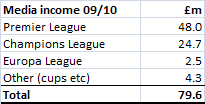
Media income is clearly a factor of both playing performance and the cycle of TV deals (note Liverpool include their own media operations (formerly in LFCTV) under "commercial" in their accounts). Liverpool earned £79.6m from 3rd party media in 2009/10, up 7% on the prior year. This can be broken down as follows:

Although Premier League income fell as the club finished 7th vs. 2nd the year before in the league, this was more than compensated for by higher Champions League receipts. Last season was the first of a new three year cycle of Champions League TV rights and Liverpool benefited in particular from their 2nd place league finish in 2008/09 which increased their share of the English "market pool". Early exit from the Champions League at the group stages was rewarded with entry into the Europa League. The difference in TV income between the two competitions is stark, with Liverpool's run to the semi-final only earning £2.5m, barely 10% of their Champions League income.

Commercial income fell 8.3% last season (taking into account the buying in of LFCTV in July 2009). The accounts blame this on a "decrease in royalty and merchandising revenue", but the fall is quite severe to just be blamed on this. It is possible that some of the club's sponsorship deals contain Champions League qualification or league position clauses which kicked in after the poor season.

Costs in 2009/10
As with income, it is important to adjust for the LFCTV business (in the 2009/10 numbers but not in the 2008/09 figures) to see the underlying cost trends at play.

Adjusting for LFCTV, and pre-exceptional charges, the club's salary bill rose £16.5m or 16.8% on 2008/09. With the obvious exception of Manchester City, this is by far the largest rise in salaries of any non-promoted Premier League club last season. It also compares very unfavourably with the fall in revenue (City's wage bill rose 61% but at least turnover rose 44%). The increase compares to Chelsea's 4.2% increase, Spurs' 4.3%, Arsenal's 6.5% and United's 7.0%.


The huge increase in salary costs did not coincide with major spending in the transfer market. The 2009/10 season saw Liverpool sell Alonso and Arbeloa to Real Madrid with Hyypia and Pennant also leaving the club. Aquilani, Johnson and Kyrgiakos joined in the summer and Rodriguez in January. Those moves would probably suggest a small fall in wages in total.

Given a relatively stable squad, the only explanation for the enormous rise in staff costs during 2009/10 is the raft of contract extensions signed by the club during the period. In March 2009, Benitez signed a four year extension, Gerrard a two year extension in April 2009, with Agger signing in May, Benayoun in July and Torres(!) in August. In April 2010, toward the end of the financial year Reina signed an extension too. It is these six deals, especially Benitez and Gerrard's that drove up the total salary bill so much.

Liverpool's wage bill sits in the middle of the pack of clubs with aspirations of Champions League qualification, higher than Arsenal's, but around 15% lower than United's and City's.


Adjusting for the inclusion of LFCTV in the 2009/10 figures, the club managed to hold other costs in line with the prior year (the small cost of sales line was down 4.3% and other costs, ex depreciation and amortisation fell 0.6%).

Operating profits ("EBITDA")
With underlying income down 0.1% and wages rocketing up, the impact on EBITDA (earnings before interest, tax, depreciation and amortisation) is going to be obvious. Pre-exceptional EBITDA fell to £26.4m from an adjusted £42.4m (which includes £5.1m of EBITDA from LFCTV), a fall of 37.8%. The unadjusted headline decline was 29.3%.


As a measure of profits, EBITDA has certain drawbacks, and in football it clearly ignores the significant expense of transfers, but I believe it is a decent proxy for comparing the financial strength of clubs. EBITDA can be seen as the pre-transfer cash profits a club generates. It can be used for transfer spending or to support debt (such as any borrowing a club takes on to build a new stadium). It should be noted that of United's impressive £100m EBITDA, c. £45m goes out of the club each year in bond interest payments.

What is concerning for Liverpool's new owners, is that EBITDA has fallen so sharply (and so far behind rivals such as United and Arsenal) in a season when the club actually earned significant sums from the Champions League. The fall is not really due to a poor season (although 2009/10 turned out badly), but because of costs running out of control. It was with this inflated cost base that Liverpool entered the truly poor 2010/11 season. The club is undergoing a margin squeeze that has pushed EBITDA back below 2008 levels even as income has held up.


The EBITDA of £26.4m is before exceptional items. In 2009/10, there were exceptional costs of £7.8m relating to firing Rafa Benitez and his backroom staff. In 2010/11 there will of course be further charges relating to the departure of Roy Hodgson and his team.

Amortisation
Until recently the player contract amortisation charges reported by football clubs was of only academic interest. The charge reflects the accounting rules relating to transfer spending. Transfer fees are spread or "amortised" over the length of a player's contract. The introduction of UEFA's Financial Fair Play rules, which includes the amortisation charge in a club's "relevant expenses" calculation makes this number suddenly quite important. Because transfer fees are spread over the life of each contract, a period of high transfer spending will linger in a club's accounts for several years.

Liverpool's amortisation charge rose to £39.9m in 2009/10 from £37.4m the previous year. With the exception of Chelsea (in previous years) and Manchester City (now), the major clubs amortisation charges are quite similar. Amortisation is effectively a reflection of gross transfer spend (profits on player sales are dealt with elsewhere) and in recent years United, Liverpool, Spurs and Chelsea have spent roughly the same as each other on gross transfer fees. The January 2011 transfer window is a sharp break from that trend of course.

Liverpool's wage bill and amortisation charge both reflect the fact that the club has been run for a decade on the assumption of regular Champions League football.

Cash flow


The fall in Liverpool's EBITDA in 2009/10 and the exceptional costs of getting rid of Benitez are reflected in the club's operating cash flow which fell from £36.5m to £23.3m (after c. £4m of working capital inflows each year). In 2008/09, Liverpool spent considerable cash on capex, transfers and other investments. In 2009/10 by contrast (reflecting no doubt both weaker profits but more importantly balance sheet problems) total net investment fell from £56m to £17m.


Challenges and prospects for the future


Matchday revenue

This season's attendances (for a constant 27 home games) are down 4.1% on last season, reflecting the lower appeal of the Europa League vs. the Champions League and the very low attendance for the Northampton Carling Cup game. League attendances remain strong at an average of 42,820. From a revenue perspective, the fall in overall attendances will be more than compensated for by the 10%+ ticket price rises put through last summer. In recent days the club announced 6.5% increases for the 2011/12 season, or 4% excluding the VAT rise. Even taking the latest price rise into account, Liverpool will only earn around £1.7m per home game next season vs. United's £3.6m and Chelsea's £2.4m.

Failure to qualify for Europe will reduce the number of home games played next season, offsetting most of the price increase the club are putting through.

Media revenue
This season the club will have earned around £6m from the Europa League (using Fulham's run last season as a benchmark). In addition the club will receive an additional £5m from the new Premier League international rights deal and £756k extra for finishing 6th rather than 7th. Total media income of c. £64m for 2010/11 will represent a fall of around 19% on last season which shows how crucial Champions League qualification is to the major clubs. Next season Liverpool will not play in Europe at all, again reducing media income (as well as matchday).

Commercial revenue
Commercial is the area where Liverpool have kept up with their major peers with the signing of two record breaking deals. In September 2009 the club announced a four year shirt deal with Standard Chartered at a total value of "up to £81m". The "up to" presumably relates to playing performance milestones in the deal. If the club earns the maximum £81m, the Standard Chartered deal will be the highest in English football (by way of comparison United's Aon deal is worth £80m over four years and Chelsea's Samsung deal is reportedly worth £36m over three years).


Liverpool's first major commercial deal signed under the new owners is with US sportswear company Warrior Sports, a subsidiary of New Balance Athletic Shoe, Inc. of Boston. The deal which starts in 2012/13 is worth a reported £25m a year putting it on a par with United's deal with Nike (the Nike deal is often quoted as being worth £23.3m pa but there was a contractual step-up to £25.4m in 2010/11). The Warrior Sports contract is a fantastic piece of business by Liverpool that doubles the club's income compared to its previous agreement with adidas.

As the two new deals kick in, Liverpool's commercial income will become one of the highest in English football. Comparisons are complicated by LFC's inclusion of their in-house media business under "commercial", but excluding this, the Warrior and Standard Chartered deals will push commercial income up to c. £77m pa compared to United's £100m, Arsenal's £44m and Chelsea's £56m. Further progress from this level will depend on the new management team's ability to sign secondary sponsors. This is the area where United has proved so adept in recent years. United's secondary deals (Turkish Airlines, EPSON, DHL etc) will bring in around £44m in the current year, equivalent to all Arsenal's commercial revenue. In total, United earn around £55m from non-shirt and kit related deals compared to Liverpool's c. £30m.

Can costs be brought down?
As they largely relate to wages, costs are far harder to predict than income and we are left relying on newspaper "estimates" of various players' salaries. Looking at changes to the Liverpool squad since July 2010, it is hard to believe that the salary bill has gone down at all. The summer 2010 transfers may have led to a modest fall in costs as Mascherano and Benayoun departed and Cole and Meireles joining, but the January flurry probably increased the wage bill. Torres was reputedly paid £110,000 per week, whilst most estimates put Carroll and Suarez on c. £80,000 per week each.

Daglish's new three year contract is presumably on comparable terms to the £3-4m per annum Benitez and Hodgson earned at Liverpool. More importantly, it is widely agreed that the squad needs strengthening and that in today's inflationary environment (and despite a number of promising home grown youngsters) that almost certainly means another increase in the wage bill.

Debt and the stadium

Whilst the Fenway deal extinguished the pointless and ruinous "acquisition debt" Hicks and Gillett had imposed on Liverpool, it did not leave the club debt free. The 2009/10 accounts contain a "Post balance sheet events" note detailing the following facilities with RBS, put in place following the takeover:

Working capital revolver £20m
Stadium term debt facility £47m
Letters of credit facility £25m

It will not be clear until next year when the 2010/11 accounts which of these facilities have been used by the club (and possibly not even then if the revolver and letters of credit are used to support seasonal cash flow). In interviews, J W Henry has mentioned the retention of £37m of "stadium debt" and again it is not clear how this relates to the £47m term facility (is £10m undrawn?). The club's previous working capital facility (totalling £97m and including £37m of stadium debt) had an average cost of 450bps over LIBOR, and it would be reasonable to assume that margin had fallen with the new facilities (to perhaps 350bps). With 3 month LIBOR still at a rock bottom 0.26%, this would make the new facility pretty cheap for Liverpool, costing c. £1.4m for the aforementioned £37m rising to £3.5m if all the facilities were fully drawn.

At 31st July 2010, Liverpool's (seasonally high) cash balance was £18.9m, a level that is unlikely to have changed much in the subsequent financial year given the low net transfer spending and moderate EBITDA.

The challenge for the club and its balance sheet is of course what to do about the stadium. Despite recent ticket price increases, the matchday income per game generated by Anfield is far too small compared to the club's principle rivals if Liverpool want to maintain a competitive squad and firepower in the transfer market.


Since Fenway took over there has been much debate and speculation about whether the new owners will decide to build a new stadium in Stanley Park or refurbish Anfield. Financially, neither option is easy. A new stadium would cost £350-400m but could generate significant naming rights and allow a huge expansion of corporate hospitality facilities (a necessary evil in a modern ground). The cost of the refurbishment option would be significantly lower but still expensive given the configuration of the ground, the possible need to move roads etc. A refurbishment would not increase hospitality facilities as much as a new build and naming rights would be lower. The previous owners' plans envisaged a 73,000, whilst any remodelling of the existing ground would only increase the capacity to c. 60,000.

The new Financial Fair Play rules exclude investment in facilities from "relevant expenses" and the owners could theoretically just pay for a new stadium for Liverpool. It is clear from the debate over Liverpool's future ground that Fenway Sports Group are not the "benefactors" in the mould of an Abramovich. It is likely that the vast majority of any stadium costs will come from debt (as was the case with the Emirates of course). This debt burden will have to be serviced by the club and with EBITDA running below £30m per annum, the challenge is clear, especially when investment in the playing side is needed to get Liverpool back into the top four.

Conclusion: Treading a narrow path

Football clubs normally end up in financial trouble when they spend in anticipation of a level of success they do not achieve, and persistent finishes outside the top 4 increase that risk for Liverpool.

Having qualified for the competition in all but one season from 2001 to 2009, Liverpool is set-up as a Champions League club in terms of its wage structure and transfer policies, but to get back into the Champions League it needs to invest even more on the playing side and in the longer term it needs to take on substantial stadium debt just to catch up with its peers. That is a very difficult and narrow path to tread for owners who seem unlikely to inject significant equity and wish instead to rely on self-generated funds.

In 2009/10, the Champions League and Europa league contributed £12m (28%) of the club's matchday income and £27m (34%) of media income. In the current season that combined £39m has probably fallen to around £16m. In 2011/12, Liverpool will earn precisely zero from these European competition and even with the Standard Chartered sponsorship contributing and the Warrior Sports deal to come, the revenue outlook is poor without a major improvement on the pitch. Weak revenue in 2010/11 and 2011/12 means that EBITDA will remain under pressure at precisely the time when the club needs both long and short-term investment.

Liverpool fans will no doubt be optimistic that Kenny Daglish can swiftly return the club to the upper echelons of the table, but the scramble for Champions League places has of course become more competitive with the rise of City and Spurs; six into four doesn't go. Financial Fair Play and the Champions League bonanza in combination impose a dangerously perverse set of risks on top clubs. Consistent CL qualification can only be achieved with a £100m+ squad, but a £100m+ squad is really only affordable under FFP if a club qualifies.... Failure risks leaving clubs breaking the FFP rules. To avoid this catch 22, clubs must scramble around for more commercial or matchday income, but in LFC's case the latter route is fraught with problems.

Will Fenway's famed US sports experience steer them through all this? Only time will tell.

LUHG

Monday, 11 April 2011

What Stan Kroenke’s takeover of Arsenal might tell us

After years of jostling between American businessman Stan Kroenke and his Uzbek rival Alisher Usmanov, the deteriorating health of Danny Fiszman looks like it has broken the log jam in the control of Arsenal.

The price paid by Kroenke of £11,750 per share,  values  the club’s equity at £731.05m. To read across from this valuation however we have to take into account the debt on the club’s balance sheet.

The last reported balance sheet figures are for 30th November 2010 (the 2010/11 interims). This showed the following debt and cash structure:


If we add this £147.4m net debt to the value of the equity offer we get the “Enterprise Value” (“EV”) of the business.

In the case of Arsenal however, a simple EV calculation is not appropriate because the club is still selling off development properties at its old ground. The interim accounts showed the remaining properties were valued (at the lower of cost or realisable value) at £28.2m. I have assumed that these will convert into cash at a 50% premium to this carrying value and have thus adjusted the EV calculation to take this into account:


So Kroenke is acquiring control of Arsenal at an Enterprise Value of c. £836m (adjusted for the remaining property) to £878m (unadjusted).

This is a pretty hefty valuation on any measure. In 2009/10, the club generated EBITDA from its football business of £57.4m (excluding volatile profits on player sales). This implies historic adjusted EV/EBITDA multiple of 14.6x and a historic adjusted EV/Sales (football only) of 3.8x.

Comparing the valuation to Liverpool

In contrast to the Arsenal deal, Fenway Sports Group paid an EV of £300m for Liverpool last year, a historic EV/EBITDA multiple of 8.6x. At face value on that basis either FSG got a bargain or Kroenke is overpaying hugely. So what’s going on?

I think the answer here is that FSG actually paid a higher multiple for Liverpool, and Kroenke is probably getting a slightly better deal than the headline numbers imply.

The multiple of 8.6x is calculated using the £35m of EBITDA generated by Liverpool in the 2008/09 season. We do not have numbers for 2009/10 yet, but it was a poor year for the club. Having finished third in 2008/09, Liverpool only managed 6th in 2009/10 and exited the Champions League at the group stage. The failure to qualify for the Champions League in the current season will of course significantly impact profits in the current financial year too. It seems likely that it will take several years to bring Liverpool’s EBITDA back to the £35m level seen in 2008/09 and FSG’s £300m takeover should be compared to a depressed level of profitability, possibly as low as £25m which would take the multiple paid to around 12x.

Arsenal’s depressed profits and the shirt deal opportunity

In the case of Arsenal, it is possible to argue that last year’s profits of £57.4m were quite depressed. The previous year the football side of the company made EBITDA of £66.3m. The club played fewer home games in 2009/10 compared to the prior year, and this will partially reverse this season (28 played vs. 27) adding c. £3.5m to turnover and perhaps 75% of that to profits. The new overseas Premier League TV deal will also add around £5m to the club’s income this season. Even with player costs continuing to rise, EBITDA should bounce back close to 2008/09’s £66m in the current season, reducing the multiple paid to c. 12.6x:


Arsenal is also “structurally” underperforming on its Commercial side due to the (at the time prudent) decision to sign a very long stadium naming rights and shirt sponsorship deal with Emirates in 2004. The shirt element which runs to 2012 is reportedly only worth £5.5m per annum compared to the c. £20m Aon and Standard Chartered pay United and Liverpool respectively and the c. £25m pa Barcelona are to receive from the Qatar Foundation. Arsenal “should” be able to earn a similar sum to its domestic rivals from the next deal creating a step change in profitability.

Taking the expected bounce back in profits into account (and even ignoring a on better shirt deal in the future), the multiple Kroenke is paying for Arsenal looks closer to 13x than 15x EBITDA, more in line with FSG’s acquisition of a Liverpool missing out on the riches of the Champions League.

Reading across

Takeovers of Europe’s biggest clubs are very rare things, and it is therefore worth taking note when they happen. In the case of both Liverpool and Arsenal, American investors are taking a bet on the continued growth of English football which is in itself interesting. At Liverpool, John W Henry has spoken publically about UEFA’s Financial Fair Play being a key factor in buying the club and it seems reasonable to think that Stan Kroenke’s takeover show he is also a believer in the impact of the new rules. Wage inflation is a big problem even at Arsenal, where the salary bill has risen an average 7.5% per annum over the last four years. The move to the Emirates has made this affordable, but with that now complete, it is hard to see significant profit growth without the fall in player wage inflation that UEFA hope FFP will usher in.

Turning to United, the other major club around which takeover speculation always swirls, today’s benchmark doesn’t really help the Glazers. The c. 13x “normal” EBITDA multiple Kroenke is paying would value United at c. £1.3bn. Unlike Arsenal the commercial side is already highly developed, meaning there is less “upside” to go for. Unlike Liverpool, there is no new stadium growth story to hang onto. If 13x EBITDA really is the “market valuation” for a major English club and with the Glazers reportedly looking for a £1.5bn+ price tag, it doesn’t look like much will happen soon.

LUHG


Friday, 8 April 2011

Financial Fair Play - crunching the numbers

This is the first in a series of posts looking at the challenges faced by English clubs in complying with UEFA's Financial Fair Play ("FFP") rules. Next season (2011/12) is the first year when clubs' "break-even result" are calculated. The tables below shows what "break-even result" the seven English clubs that played in Europe this season would have achieved on last year's figures (Liverpool numbers are for 2008/09 as they have not yet published 2009/10 results).

Relevant income


The "relevant income" calculation is the simplest bit of the FFP rules. All football club revenue (which I have divided into the common matchday/media/commercial and retail split) is of course included. In addition, the profit from selling players is included too. Profit in this sense means the difference between a player's selling price and the book value of his registration on the club's balance sheet. Players that come through a club's youth system have a zero book value and thus any sale proceeds are 100% "profit" in the FFP calculations.

Income from non-football operations is excluded, except where they are based at or close to a club's ground (such as hotel or conference facilities). Chelsea's hotel would therefore be included in the income calculation, as would Manchester City's "Sportcity" redevelopment around Eastlands. Arsenal's property income from the re-development of Highbury would be excluded.

The other major exclusion, and one no doubt likely to cause controversy, is revenue received from "related parties" (effectively the owner or people/corporations connected to them) in transactions that are carried out "above fair value". This rule (described in Annex X B 1j) says that transactions with a related party must be compared to the "fair value" that would have been achieved if the transaction was done as a normal commercial deal. Any income above this "fair value" is disregarded when calculating a club's income. This rule is designed to prevent owners subsidising their club by, for example, paying £50m per year for a box that would normally cost £250,000.

Relevant expenses


The expenses element of the FFP is more complicated and less intuitive than the income side. Staff costs are included and are by far the largest element, indeed it can be argued that the whole aim of FFP is to bear down on staff costs across European football. Other cash operating expenses are included (the basic costs of running a football club), but depreciation of fixed assets is not included. This means that there is no account taken under the FFP calculation of any costs from investing in stadiums or training grounds. Owners can finance such capital expenditure without limit under FFP.

Finance costs such as interest payments are included, but not if they relate to borrowing taken on to construct "tangible fixed assets" such as stadia, training facilities etc. In the table above, I have deducted the c. £14.5m of Arsenal's £20.8m of interest costs that relate to the club's financing of the Emirates.

The interest figure for United excludes the significant one-off refinancing costs the club recognised in 2009/10. My understanding is that such costs would not be included under FFP. On an ongoing basis, United's bond interest will be around £44.5m per annum.

A vital element of the expenses calculation is the inclusion of the "amortisation of player contracts" charge, which is how the cost of transfers is accounted for.

The accounting treatment of transfer spending is one of the least intuitive elements of finance for most football supporters. In the UK, the treatment is covered by "Financial Reporting Standard 10: Goodwill and Intangible Assets". In a transfer, the asset that is being bought and sold is not of course the player himself but the player's registration. This "asset" has a finite length of course, being the length of the player's contract with the acquiring club and FRS 10 says that the cost of buying the registration must be "recognised" over that life.

So when a club "buys" a player on a five year deal for (say) £20m, the cost is recognised over the 5 years at £4m per year, this is the "amortisation charge" for that player that appears in the profit and loss account. The timing of cash payments is irrelevant. The money could be paid up front or in agreed stages but the "cost" is recognised evenly over the contract. If after (say) three years the player negotiates a new five year deal, the remaining value (£8m in this example) plus any costs of negotiating the new contract (hello Paul Stretford et al) are added together and then recognised over the life of the new contract.

By including the amortisation charge in the expenses calculation, FFP captures transfer spending over an extended period. Even if a club stops spending after a period of heavy investment, the amortisation charge will stay high for a prolonged period. The chart below shows my estimate of Manchester City's charge over the next five years assuming no further purchases or sales (other than those players currently out on loan).


Dividend payments are captured in the calculation (in order to ensure debt is not disguised as equity). If the Glazers exercise any of their dividend rights (currently around £95m), such payments would have to be included in the FFP calculation.

As with the income calculation, transactions with "related parties" not done at "fair value" are adjusted for in the relevant expenses calculation. This is to prevent owners subsidising their clubs through taking on club costs (such as directly paying players for example).

The final major adjustments in the expense calculation relate to spending on youth development and community activities. Both are excluded from the FFP numbers, meaning clubs can spend as much as they wish on these areas. I have estimated figures for all seven clubs as they are not separately disclosed in the accounts.

Income minus expenses = "break-even result"


Subtracting "relevant expenses" from "relevant income" gives us the all important "break-even result". This is the key figure under the new regulations. In the first two "monitoring periods", seasons 2011/12 and 2012/13, clubs are not permitted to make a loss greater than €45m (c. £39.5m) over these two years combined if they are to receive a licence to play in Europe in 2013/14.

As you can see from the table above, only three or the seven English clubs would have made a profit under the break-even calculation last year, and Spurs' profit was only due to profits on player sales. United would have shown a loss if the exceptional financing costs were included. The losses at both Chelsea and City stand out. The figures for Liverpool are misleading, because they include significant finance costs relating to the debt Hicks and Gillet loaded on the club which have now been cleared.

Enforcement and exemptions
Meeting the new rules is going to be hard for many clubs across Europe. A key question is the extent to which  UEFA actually enforce their new rules. The credibility of Michel Platini and UEFA as an organisation are clearly on the line, and I believe they will be enforced, although that may well mean banning a major club from European competition.

The rules do give one notable exemption to the calculations I have outlined for the first two seasons in which the rules apply (2013/14 and 2014/15), set out in Annex XI 2, the final page of the regulations. If a club breaches the "break-even" target in the "monitoring periods" for either of these seasons because of a loss in the 2011/12 season caused by wages paid to players under contracts signed before 1st June 2010 (when the FFP rules were published) the club will be let off (as long as losses are reducing over time). That is quite a big get out, and may well mean that City and Chelsea do not face the imminent prospect of a European ban. The exemption is only temporary however and the principle remains the same, if UEFA enforce FFP, many clubs are going to have to cut their wage bills and/or radically boost their revenues in the next few years.

LUHG