Showing posts with label MCFC. Show all posts

Tuesday, 18 December 2012

MCFC's financial results - waiting for BT to ride to the rescue

City's 2011/12 annual report and accounts contains the usual mix of giddy blueness (apparently more people choose to be City than United when playing EA Sports FIFA 2012 - wow), photos of blue Santas and lashings and lashings of red ink.

For a club like Manchester City of course, losses don't really matter whilst the owners are prepared to carry on writing cheques. In the last four financial years, the club has made pre-tax losses of £510.9m, all of which have been funded (through equity) by Abu Dhabi United Group Investment & Development Limited.

What is interesting in the City figures is how the club is getting on with meeting the new UEFA Financial Fair Play ("FFP") regulations and how this will change the way the club is run. The first FFP hurdle is the 2013-14 "monitoring period" which looks at profits/losses (on UEFA's definition) in the prior two seasons (2011/12 and 2012/13). Over these years, losses should not exceed €45m (c. £36.5m at today's exchange rate).

So how are City doing?

A quick glance at the profit and loss account suggests a long way to go, with a pre-tax loss of £97.9m. This is however a massive improvement on the £197.5m loss in 2010/11 (albeit this included £35m of "exceptional" costs).

Revenue - massive

The huge reduction in losses is driven by a 59% increase in income at the club. In the table below I have changed the way the club present Commercial income to bring it into line with most other clubs by including hospitality income in "Matchday".


The increase in Matchday was driven by higher average attendances (league gates averaged 47,031 vs 45,885 in 2010/11), one extra cup game and higher cup attendances from being in the Champions League.

The growth in TV income reflects the impact of the club's short lived Champions League campaign which added £18m in extra UEFA TV money.

The eye-catching growth comes of course from Commercial revenue and in particular "partnerships". Commercial income rose 102% to £109.4m in 2011/12 with 89% of this coming from the club's commercial partners. To put these numbers into context, United's total Commercial income in 2011/12 was only £8m higher than City's and (whilst definitions vary slightly) it looks to me that City's non-kit partner revenue was higher than United's.

I will leave it to readers to decide for themselves whether City would have managed to get to almost £100m of partnership revenues if they hadn't been owned by a member of the Abu Dhabi royal family. Perhaps Etihad, TCA Abu Dhabi, aabar and Etisalat would have all signed up as City's sponsors if Thaksin Shinawatra or even Franny Lee was the owner..... Such debates are pretty superfluous, other clubs have established the benchmark for commercial income at £100m or more per annum and a legally well advised MCFC will no doubt meet that benchmark as long as the club is owned by ADUG.

Costs - some signs of control

Whilst City's income rose 60% last season, cost control was actually quite good. Total staff expenses rose 16% to an English record £202m (by comparison Arsenal spent £143m and United £162m) but there were obviously significant bonus payments for winning the league meaning underlying growth in the wage bill was probably no more than 5-7%.


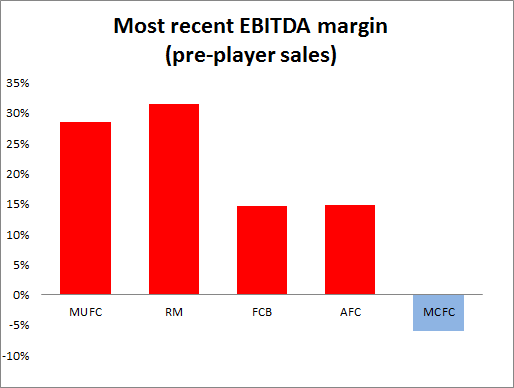
The key profit measure of EBITDA (essentially cash profits/losses before investment) was greatly improved with the loss before player sales down to £14.5m (a negative margin of 5.9%). This profit performance is  still a long way off that of the major clubs with sustainable models (see chart below), but for the first time since the ADUG takeover, City are only making a small operating loss before investment spending.

Below the EBITDA line comes the cost of transfer spending - the amortisation charge. Whilst net cash transfer spending in the season fell to £95.2m from £143.4m, the amortisation charge only fell 1% to £83.0m. Amortisation lags transfer spending and only reflects purchases not sales. To make a major dent in the amortisation charge (which is included in the FFP calculation), the club will have to rely far more on home grown talent than currently is the case. It is a key characteristic of the FFP rules that spending on youth development is not included in the profit/loss calculation whilst transfer spending is. Across in M16, United's amortisation charge has never exceed £41m in any season as the club has had a constant stream of players coming through the youth system.

The FFP "breakeven" calculation

Although UEFA are not going to publish individual clubs' FFP figures it is quite easy to calculate a decent estimate. The items included in the calculation are set out in Annex 10 of the regulations. There are two main items which are not readily identifiable from most clubs' accounts; the total spending on dis-allowable items such as youth development and community programmes, and wages and salaries relating to contracts signed before the regulations were published in June 2010. 

Although not in City's accounts, the club have briefed journalists that there are £15m of dis-allowable expenses relating to youth development so I have used this figure.

I have shown calculations both including and excluding the sale of intellectual property rights to ADUG for £12.8m. There is no detail on this transaction, but it looks like a one-off.


The bottom line is that City reported an FFP loss of £79-92m last season. At first glance this looks like a pretty poor result vs. the target of £36.5m over two seasons, but some journalists are reporting that around £80m relates to player contracts signed before June 2010. This looks very high to me given the number of contract renewals that have taken place (the major players still on pre-June 2010 contracts are Tevez, Kolo Toure, Lescott and Barry), and I wonder whether journos have misunderstood and that the £80m is a projection over both last season and this one. In any event there will be a substantial amount that UEFA will ignore in making their calculations.

The key point however is that breaches of FFP in the first monitoring period are very, very unlikely to result in severe punishment, especially if losses are reducing (they are) and the club can show strong evidence that it is moving towards compliance, and here they have BT to thank.....

BT - the football club owner's best friend

The recent domestic PL rights auction transforms the outlook for clubs like City who are struggling to comply with FFP. The entry of BT into the market caused the value of domestic rights in the next three year cycle to rise by 70% (compared to a 3% rise in the previous three years period). BT's Ian Livingston is taking a huge gamble that he can break BSkyB's vice like grip on the UK sports pay TV market. He is betting £246m per annum that BT will succeed where Setenta, ITV Digital and (arguably) ESPN have failed.

Livingstone: Visionary or sucker?
The exact impact on clubs' finances from the new three year cycle will depend on the eventual uplift achieved from international rights. Assuming a 50% uplift, the amount going to the league champions will rise from c. £60m to c. £100m (see Sporting Intelligence's excellent article for a full analysis). The uplift for a relegated club will be around £25m.

Closing City's FFP gap

Manchester City are very lucky that Ian Livingstone decided to barge into the market when he did. The £40-50m extra will alone more than halve the club's FFP deficit when the new cycle starts in 2013-14.

Even before this new bonanza, however, the FFP gap will close somewhat. The club's share of the CL "market pool" will rise significantly this season because they are English Champions, adding c. £7-8m. City will also benefit modestly from the general 20% uplift in the amount clubs receive from the Champions League. The Nike kit deal signed in May 2012 will add another £9-10m per annum vs. the current Umbro deal. There will no doubt be further second tier sponsors announced in the coming months as well.

As described above, the amortisation charge lags behind transfer spending, but with net cash transfer spending year to date down to £39m, the total charge should begin to fall from this year onwards (down by about £10m on my estimates).

Taking these items together and assuming a top two finish, this season will see £30m+ improvement and  by next season the gap will have closed by £70m+. Further trimming of the squad, especially high wage/non-playing players looks very likely. The club no doubt expects to begin to reap rewards from its youth development spending, whether through reduced transfer spending or increased player sales income. Also further out, there is potential for the developments around the stadium and the new Etihad campus to yield profits too.

Finally, if City can start to work out the Champions League, there is a further £25m+ to be earned from getting into the late knock-out stages.

A calmer future?

City will no doubt miss the first break-even result test, despite the exclusion of pre-2010 contracts. Crucially however, there is decent visibility on a very substantial improvement in the club's FFP position over this season and even more next season as the PL TV bonanza rolls in.

The club has been very, very lucky that TV income is continuing to rise so fast. There is no possibility that City would have been able to reconcile £200m of staff costs with the FFP rules without the enormous rise in TV money coming in the next 18 months. 

City still have much to do however. The "buy success" model needs to be replaced with a proper youth set-up that delivers high quality players. In the current first team squad, Micah Richards is the only player to have come through the ranks. Net transfer spending will have to fall and stay lower to keep the amortisation charge at a reasonable level. An £80m charge and a £200m wage bill are not compatible with a club generating £33m in matchday income (although the ticket price policy is to be applauded). Manchester City need to "bank" every penny of extra revenue they receive in the next two to three years.

For competing clubs, it doesn't look as if FFP is going to lead to major cutbacks at City, BT have seen to that. For those clubs who don't have sugar daddies, the outlook is still good. City can live with FFP, but they are going to be have to calm down to do so, and that has to be good for everyone else.....

LUHG


Wednesday, 13 July 2011

A look at Manchester City’s commercial income

NOTE:
I am a United supporter, if you feel this makes me a "biased rag bastard" who is incapable of writing about Manchester City's finances in an impartial way then I believe you are mistaken. If that is however your view, I suggest you don't waste your time reading on!

Alongside the usual summer transfer speculation, the biggest football news of last week was Manchester City’s new ten year naming rights and sponsorship deal with Etihad Airways. Reports indicate that Etihad will pay City between £300m and 400m over the life of the contract making it by far and away the largest ever club football sponsorship deal. With UEFA’s Financial Fair Play rules around the corner, the Etihad deal has caused huge controversy with figures such as John W Henry of Fenway Sports Group and Arsene Wenger questioning the transaction given that Etihad is owned by the Abu Dhabi royal family of which City's owner Sheikh Mansour is a senior member.

This post takes a closer look at the sources of City’s commercial revenues and how they have grown over recent years. I have assumed a figure of £400m for the Etihad deal throughout for ease, but readers can obviously make the easy mental adjustment if they believe £300m is a more realistic figure. As with all my posts, I will correct any inaccuracies readers point out.

Splitting out commercial income from the report and accounts

Most football clubs adopt a three way split of revenue between Matchday, Media and Commercial sources. Unusually Manchester City include corporate matchday hospitality business under a catch all segment called “Other commercial activities” and then publish a separate figure for “Gate Receipts”. To make sensible comparisons with other clubs we need to deduct matchday hospitality from the “Other commercial activities” total. Thankfully the 2009/10 accounts give the details on page 55 allowing us to strip hospitality and to then disaggregate the total Commercial (ex-hospitality) revenue into Commercial partnerships (i.e. sponsors), retail and merchandising and “other” (I have rounded to the nearest £100k for ease).


2008/09 – the bad old days

The accounts show that in Sheikh Mansour’s first year of ownership the deals he inherited from the previous owner only generated £6.5m in sponsorship revenue and £17.9m in commercial income as a whole (by comparison United’s commercial revenue for the same year was £70m). 

The two key commercial arrangements in force that season were the shirt sponsorship with Thomas Cook and the kit deal with Le Coq Sportif. The kit deal was widely reported to be worth £10m over four years and the Guardian reported that the Thomas Cook were paying £3m for their two year deal with City. The only other current sponsor involved with the club at that time was the local radio station Key 103. I’ve estimated that at £500k pa, leaving £2m from other small deals.


2009/10 – transformation

The 2009/10 accounts say:
Financial highlights for 2009-10 include: Corporate partnership revenue increasing by £25.9m to £32.4m, an increase of nearly 400% on the previous year, driven by new long term deals with a number of key partners, including Etihad Airways, Abu Dhabi Tourism Authority, Aabar and Etisalat.” (page 55)
By the end of the 2009/10 financial year, the four new sponsors mentioned above, along with Umbro, had replaced all the club’s previous sponsors (with the exception of Key 103). In other words, the £32.4m generated by the club in 2009/10 came solely from six companies. The original Etihad shirt sponsorship was widely reported to be worth £7.5-8m pa. To get to a total of £32.4m therefore (and assuming Key 103 continued to pay £500k pa), the other three Abu Dhabi owned sponsors and Umbro had to generate approximately £23.9m in revenue between them. The table below shows my estimate of how this splits between sponsors:


I have used a figure of £2.9m pa for Umbro to reflect some sort of premium over the Le Coq Sportif deal, despite several press reports suggesting the ten year partnership was only worth £25m. With The Etihad shirt sponsorship in at £8m, the £7m each for the other three Abu Dhbai companies is just the residual needed to get to a total of £32.4m. This figure of £7m each (or rather a total of c. £21m for all three) is pretty staggering given they are second tier sponsors.

2010/11 – broadening the base

If the first year of Mansour’s ownership reflected the financial failures of Thaksin Shinawatra and the second year saw huge deals being signed with friendly companies from Abu Dhabi, the third year saw a decent diversification of the base of sponsors.

The German heavy engineering group Ferrostaal signed a sponsorship deal at the end of calendar 2009 shortly after being taken over by International Petroleum Investment Company of Abu Dhabi. Strangely Ferrostaal no longer appears on the club’s list of sponsors and the pre-season “Ferrostaal Cup” competition promised for 2010, 2011 and 2012 doesn’t appear to be happening this year.

More importantly than whatever is happening with Ferrostaal, the last financial year saw City sign deals with Amstel (i.e. Heineken), Malmaison Hotels, Thomas Cook Sport and Jaguar, none of whom are owned by Abu Dhabi or its royal family. Assuming £2m per partnership (and the same for Ferrostaal), this will add c. £10m to the £32.4m achieved in 2009/10.


2011/12  - The second Etihad deal

A massive deal

The £400m, 10 year deal announced last week is a staggering piece of business for City. A club that could only muster £6.5m in total sponsorship income under Thaksin has signed a deal worth over six times that from just one source.

It appears that City and Etihad are suggesting the partnership splits into three areas; shirt sponsorship, naming rights for the (former) City of Manchester Stadium and naming rights for the wider “Etihad Campus” in East Manchester (see below). Even with the c. £40m split into these three areas (and perhaps £4m pa going back to Manchester City Council for the first five years), these are sums that match or exceed the best deals seen in European football. United and Liverpool’s shirt deals with Standard Chartered and Aon respectively are worth around £20m pa. Bayern Munich’s 2009 three year extension of its shirt sponsorship with Deutsche Telekom is worth around £23m pa. Precedents for naming rights in Europe are somewhat scarce, and if City’s Etihad deal is worth around £10m pa, it is the highest seen in European sport.


Etihad is a young airline benefitting from significant investment from the Abu Dhabi royal family but it is hard to see the business logic for a deal of this scale. Etihad’s annual turnover is only around £2bn (annualising its recent half year figures). On 12th July it proudly announced it had broken even for the first six months of 2011 (the first breakeven result in its eight year life), but this “breakeven” is as measured by “earnings before interest, tax, depreciation, amortisation and rental payments (on leased planes)”. Few airlines ever achieve an operating margin of more than 15%, and even if Etihad could hit that sort of level of profitability, this deal would mean it was then paying out 10-15% of its annual profits to City. For such a company to pay out £400m over ten years to a not especially well known European football club is somewhat strange from a business perspective.


Other sources of commercial income

So far I have just discussed commercial partnership income. Like all clubs, City has a merchandising operation (in conjunction with Umbro) which turned over £7.9m in 2009/10, an impressive increase on the £5m figure for 2008/09. It seems unlikely that this growth rate can be sustained, but it is reasonable to expect some growth as City’s international profile begins to rise.

Streets soon to be paved with gold....


Far more intriguing than shirt sales is what City can do with the 80 acres of development land around the stadium. Formally called (by the council) “Openshaw West”, this is now going to become the “Etihad Campus”. So far nobody knows exactly what will be built on this land, although suggestions include retail and office space (including a new Etihad call centre), a new training ground for the club, a sixth form college, a sports science complex etc, etc. Any construction costs borne by Sheikh Mansour fall outside the scope of “expenses” under Financial Fair Play rules but any profits from activities on this land can be included (as the “campus” is on land adjoining the ground).


How City compare to other clubs

The £46.7m City earned from all Commercial activity in 2009/10 took it above Arsenal and Spurs for the first time.


In the season just finished the five additional sponsors will have added another £10m and no doubt merchandising revenue will have risen too on the back of the club’s first trophy in thirty five years. When the additional income from Etihad is added from this year onwards, City will almost certainly overtake Chelsea (2009/10 Commercial revenue £56m) and be close to Liverpool (2009/10 Commercial revenue £62m but this predates the Standard Chartered and Warrior deals) and will be reporting total commercial income of around £90m (depending on the exact size of the Etihad deal). In English football only United (where commercial income will exceed £100m in 2010/11) can rival this.

The elephant in the room - Financial Fair Play and the reliance on Abu Dhabi

Unlike most clubs, City’s search for additional income is not about boosting their firepower in the transfer market or (as with the Glazers) boosting the club’s value, it is about compliance with Financial Fair Play. In my piece on 8th April I estimated that City would have reported a deficit on 2009/10 results of around £121m under the new FFP calculations (although importantly this is before the permitted adjustment for player contracts which were entered into prior to June 2010 that applies to the first two years of the new regulations).

The incremental c. £44m the club has added in Commercial income since 2009/10 reduces that deficit by a third, and Champions League participation and top four finishes (if repeated) will add another c. £30-35mpa. That begins to make the €45m (c. £40m) loss allowable over two years under FFP look achievable, but there is still much to do, especially with a bloated squad costing £130m+ in wages and £70m+ in annual amortisation charge on transfer spending.

The club’s reliance on companies owned by Abu Dhabi’s royal family is stark. Although the deals with Malmaison, Jaguar etc reduced the percentage of sponsorship income coming from such companies from 90% in 2009/10 to c. 73% last season, the new Etihad deal takes it back to 85%. Other clubs are understandably aggrieved at what they see as an attempted flouting of the new FFP rules. My personal view is that UEFA will not stand in the way of any of the Abu Dhabi related transactions, as each could just about be justified individually.


Manchester City clearly believe they have found a way through the FFP regulations that effectively channels Abu Dhabi's wealth into the club in bite sized and UEFA compliant chunks from various nominally independent sources. It will be very hard for UEFA to argue against these deals, but there is surely a limit to how far City can push this process. With commercial revenues now rivalling United, Real Madrid and Barca, further closing of the FFP gap is going to have to come from the more traditional source of controlling costs and winning trophies.....

LUHG

Friday, 8 April 2011

Financial Fair Play - crunching the numbers

This is the first in a series of posts looking at the challenges faced by English clubs in complying with UEFA's Financial Fair Play ("FFP") rules. Next season (2011/12) is the first year when clubs' "break-even result" are calculated. The tables below shows what "break-even result" the seven English clubs that played in Europe this season would have achieved on last year's figures (Liverpool numbers are for 2008/09 as they have not yet published 2009/10 results).

Relevant income


The "relevant income" calculation is the simplest bit of the FFP rules. All football club revenue (which I have divided into the common matchday/media/commercial and retail split) is of course included. In addition, the profit from selling players is included too. Profit in this sense means the difference between a player's selling price and the book value of his registration on the club's balance sheet. Players that come through a club's youth system have a zero book value and thus any sale proceeds are 100% "profit" in the FFP calculations.

Income from non-football operations is excluded, except where they are based at or close to a club's ground (such as hotel or conference facilities). Chelsea's hotel would therefore be included in the income calculation, as would Manchester City's "Sportcity" redevelopment around Eastlands. Arsenal's property income from the re-development of Highbury would be excluded.

The other major exclusion, and one no doubt likely to cause controversy, is revenue received from "related parties" (effectively the owner or people/corporations connected to them) in transactions that are carried out "above fair value". This rule (described in Annex X B 1j) says that transactions with a related party must be compared to the "fair value" that would have been achieved if the transaction was done as a normal commercial deal. Any income above this "fair value" is disregarded when calculating a club's income. This rule is designed to prevent owners subsidising their club by, for example, paying £50m per year for a box that would normally cost £250,000.

Relevant expenses


The expenses element of the FFP is more complicated and less intuitive than the income side. Staff costs are included and are by far the largest element, indeed it can be argued that the whole aim of FFP is to bear down on staff costs across European football. Other cash operating expenses are included (the basic costs of running a football club), but depreciation of fixed assets is not included. This means that there is no account taken under the FFP calculation of any costs from investing in stadiums or training grounds. Owners can finance such capital expenditure without limit under FFP.

Finance costs such as interest payments are included, but not if they relate to borrowing taken on to construct "tangible fixed assets" such as stadia, training facilities etc. In the table above, I have deducted the c. £14.5m of Arsenal's £20.8m of interest costs that relate to the club's financing of the Emirates.

The interest figure for United excludes the significant one-off refinancing costs the club recognised in 2009/10. My understanding is that such costs would not be included under FFP. On an ongoing basis, United's bond interest will be around £44.5m per annum.

A vital element of the expenses calculation is the inclusion of the "amortisation of player contracts" charge, which is how the cost of transfers is accounted for.

The accounting treatment of transfer spending is one of the least intuitive elements of finance for most football supporters. In the UK, the treatment is covered by "Financial Reporting Standard 10: Goodwill and Intangible Assets". In a transfer, the asset that is being bought and sold is not of course the player himself but the player's registration. This "asset" has a finite length of course, being the length of the player's contract with the acquiring club and FRS 10 says that the cost of buying the registration must be "recognised" over that life.

So when a club "buys" a player on a five year deal for (say) £20m, the cost is recognised over the 5 years at £4m per year, this is the "amortisation charge" for that player that appears in the profit and loss account. The timing of cash payments is irrelevant. The money could be paid up front or in agreed stages but the "cost" is recognised evenly over the contract. If after (say) three years the player negotiates a new five year deal, the remaining value (£8m in this example) plus any costs of negotiating the new contract (hello Paul Stretford et al) are added together and then recognised over the life of the new contract.

By including the amortisation charge in the expenses calculation, FFP captures transfer spending over an extended period. Even if a club stops spending after a period of heavy investment, the amortisation charge will stay high for a prolonged period. The chart below shows my estimate of Manchester City's charge over the next five years assuming no further purchases or sales (other than those players currently out on loan).


Dividend payments are captured in the calculation (in order to ensure debt is not disguised as equity). If the Glazers exercise any of their dividend rights (currently around £95m), such payments would have to be included in the FFP calculation.

As with the income calculation, transactions with "related parties" not done at "fair value" are adjusted for in the relevant expenses calculation. This is to prevent owners subsidising their clubs through taking on club costs (such as directly paying players for example).

The final major adjustments in the expense calculation relate to spending on youth development and community activities. Both are excluded from the FFP numbers, meaning clubs can spend as much as they wish on these areas. I have estimated figures for all seven clubs as they are not separately disclosed in the accounts.

Income minus expenses = "break-even result"


Subtracting "relevant expenses" from "relevant income" gives us the all important "break-even result". This is the key figure under the new regulations. In the first two "monitoring periods", seasons 2011/12 and 2012/13, clubs are not permitted to make a loss greater than €45m (c. £39.5m) over these two years combined if they are to receive a licence to play in Europe in 2013/14.

As you can see from the table above, only three or the seven English clubs would have made a profit under the break-even calculation last year, and Spurs' profit was only due to profits on player sales. United would have shown a loss if the exceptional financing costs were included. The losses at both Chelsea and City stand out. The figures for Liverpool are misleading, because they include significant finance costs relating to the debt Hicks and Gillet loaded on the club which have now been cleared.

Enforcement and exemptions
Meeting the new rules is going to be hard for many clubs across Europe. A key question is the extent to which  UEFA actually enforce their new rules. The credibility of Michel Platini and UEFA as an organisation are clearly on the line, and I believe they will be enforced, although that may well mean banning a major club from European competition.

The rules do give one notable exemption to the calculations I have outlined for the first two seasons in which the rules apply (2013/14 and 2014/15), set out in Annex XI 2, the final page of the regulations. If a club breaches the "break-even" target in the "monitoring periods" for either of these seasons because of a loss in the 2011/12 season caused by wages paid to players under contracts signed before 1st June 2010 (when the FFP rules were published) the club will be let off (as long as losses are reducing over time). That is quite a big get out, and may well mean that City and Chelsea do not face the imminent prospect of a European ban. The exemption is only temporary however and the principle remains the same, if UEFA enforce FFP, many clubs are going to have to cut their wage bills and/or radically boost their revenues in the next few years.

LUHG


Wednesday, 19 January 2011

David Gill says Manchester United can compete with City in the transfer market – but we aren’t spending


David Gill today reaffirmed his confidence in United's business model and our ability to compete financially with City. I don't disagree that United generates excellent profits. It's also worth remembering that the club has built up (at 30th September 2010) a cash pile of £151.7m primarily from the unspent Ronaldo money and the Aon prepayment.

David says that "We can compete, we can compete for top players". That may be true, but all the evidence is that whatever we "can" do, we haven't chosen to spend very much, certainly no where near as much as City. For whatever reason we have allowed huge amounts of cash to build up on the balance sheet and have spent little on either transfers or capital expenditure (except in 2006 when c. £30m was spent on completing the quadrants).

I and many other commentators thought the cash pile was going to be used to repay the PIKs, but they have been dealt with from a mysterious, unknown source.

The Glazers retain the dividend rights (currently they can take around £120m if they wish) that were secured with the bond issue, at a cost in higher interest payments of course. Perhaps that is why we are sitting on all this money.

In any case, and rightly or wrongly, whether we "can" compete with City's funny money, we are most certainly choosing not to at the moment (see charts below, all numbers are £'000s):


Our record on the pitch in the last few years hardly cries out for a Cityesque splurge of transfers, but it's also worth remembering that none of United's cash has been used to reduce ticket prices or on expanding the ground since 2006.

Given all the surplus cash at United, the club could take £100m of the cash, cut all ticket prices (STs, members' tickets, juniors, seniors and execs) by 15% and then freeze them for seven years. We'd still have £50m in the bank plus the profits generated each year. Unless the Glazers are keeping the money there for some other reason......

LUHG

Thursday, 28 January 2010

Massive

Feeling a little jaded today.  You really can't beat injury time winners against little city.....

But how little are they? Here's a snippet (from the accounts to 31st May 2009 City slipped out on 13th January and the recent United accounts to 30th June 2009):


Turnover City United
Matchday £15.4m £108.8m
Media £48.3m £99.7m
Commercial £28.3m £69.9m
Total £87.0m £278.5m

EBITDA City United
2008/09 -£30.7m £91.3m

Obviously the 40% cumulative ticket price rises at United since 2005 make that £109m number possible, but ask yourself this:

a) Isn't Michel Platini right?  Isn't the financial tragedy of football both United style debt but also the fantasy world of £31m+ annual losses funded by rich men who feel nothing for their club toys?


but more importantly....


b) Aren't City a MASSIVE club?


LUHG